Thursday, September 22, 2016

Making Our Mathematical Thinking Visible

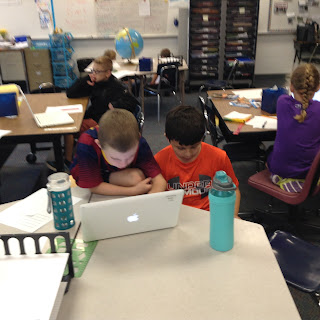
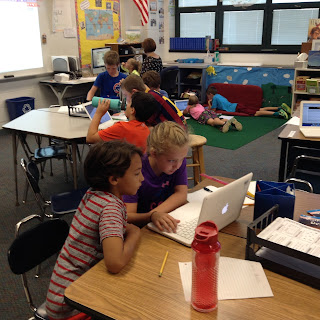
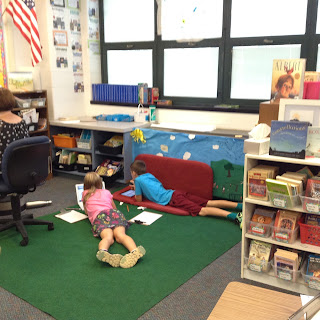
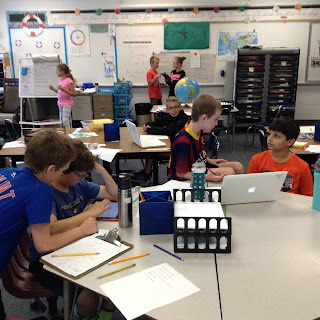
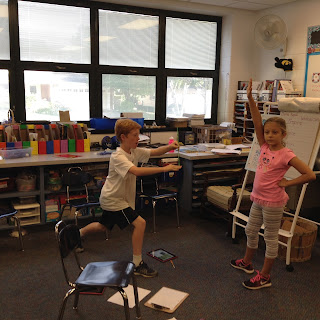
We've been approaching math in a very collaborative, cooperative way this year.  In order to encourage metacognition, and the ability to articulate our mathematical strategies, we've been answering open ended questions. Students discuss their thinking about concepts, label what they know, represent their understanding with notes, and help each other build a deeper understanding of our concepts.  It also shows kids that there are a variety of ways to think about mathematical concepts, and we can be flexible in our approaches to solving open ended problems. The thinking and learning that comes out of these discussions is so rich.  Here are some pictures of our latest mathematical discussions, when students were working together to think about what they could do with a set of numbers.  

"We can put these numbers in numerical order and find the median"

We can add them all together (which we later translated into finding the mean by dividing by the total #s in the set).

Each of these students here used a different strategy to add all their numbers.  It was interesting to see the different strategies at work. 


Add caption

We can use the individual digits to make bigger numbers. (That's one of our place value concepts this unit)


After finding all the data landmarks, this student commented that his notes looked like a Cat in the Hat hat.
He later drew a Cat in the Hat for us for homework, so that we can remember all of our landmark data.  I will post a picture of his finished product.


To Plant or Not to Plant

Following our discussion about doing a good deed in remembrance of 9/11, Keith brought in a packet of seeds that are the same variety of wildflowers growing in the field where Flight 93 crashed in Pennsylvania.  He wrote a letter to Mrs. Beane and Mrs. Sessler asking if our class can plant the flowers at Dryden, as our good deed. Mrs. Beane responded with a variety of questions about the flowers for us to answer, in order to decide if Dryden is the appropriate place to plant these flowers.  So, once again, we began to research.  Keith divided the class into teams of 2, and we quickly  found the answers to all of Mrs. Beane's questions.  We compiled all of our research into a big grid, and used the information to make judgements about how we can move forward with this project.  The kids just broke into new teams, in which they will use the information they learned about the flowers to determine our recommendations for the best place to plant the flowers, a plan for how we will control them from spreading, a long term plan for care, and they will also be studying the impact the flowers will make on the environment around Dryden.  Stay tuned for our decision.


How tall will our flowers grow?(If you look closely, you will see Dawson measuring with a ruler)

Landscape/Landform Book Clubs

We've been studying landscapes and landforms around the world in our Science and Social Studies units.  Why not connect it to reading, as well.  Groups of students read a variety of nonfiction and fiction books and looked for information about landscapes and landforms within them.  In our nonfiction books, students focused on using the index, table of contents, and other text features to find specific information about landforms that might be found in that particular continent, country, or region.  The readers of the fiction books paid attention to the landforms that were involved in the story and how they played a part in the setting and the events of the story.  Each group is currently working on a way to share the information they got from their book.